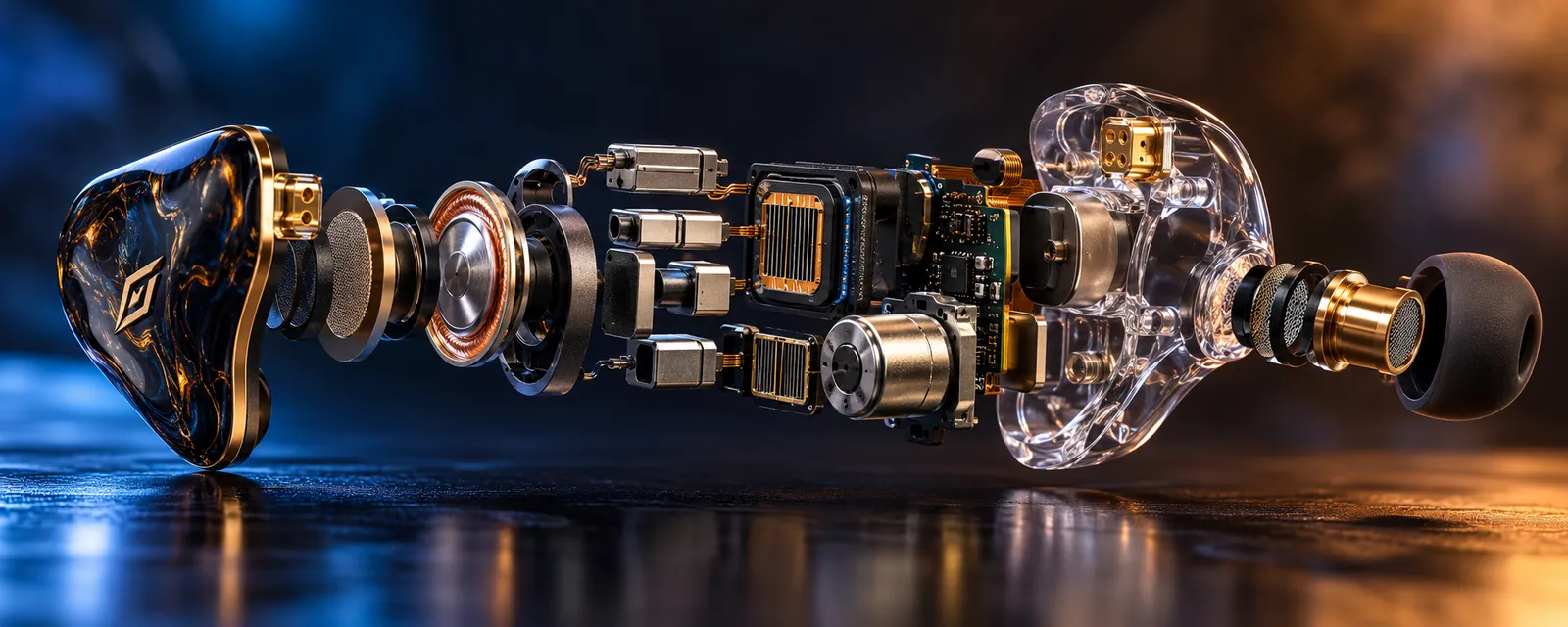
Important note: This is an educational illustration. Not every IEM contains Dynamic Driver, Balanced Armature, Planar Magnetic, Electrostatic, Bone Conduction and Micro Planar together.
ADVERTISEMENT SPACE — MIDDLEAdvertisement size: 1200 × 200 px • WebP / JPG / PNG • ideally under 200 KB
DRIVERS
What is a driver?
A driver is a transducer that converts an electrical signal into mechanical movement, moves air and creates sound. “More drivers = better sound” is not a rule; implementation and tuning matter.
COMMONDynamic Driver (DD)
A voice coil and magnet move a diaphragm forward and backward. This design is commonly used to produce bass because of its larger excursion.
Benefit
Bass extension, coherent presentation
Note
Diaphragm material, motor and tuning all affect the result.
Balanced Armature (BA)
A design that moves a diaphragm using armature movement inside a small enclosure. Its compact size makes multiple drivers practical.
Benefit
Compact, efficient, multi-driver designs
Note
Implementation, crossover, acoustic design
Planar Magnetic
A thin flat diaphragm carries conductive traces, and a magnet array drives its movement. It is now used in IEMs too.
Benefit
Low moving mass potential, strong bass extension
Note
Size, damping, seal, tuning
Electrostatic
A very thin diaphragm is driven by electrostatic force. In IEMs it is often used for the very-high-frequency section.
Benefit
Very light diaphragm
Note
Dedicated energizer / implementation
Bone Conduction / Piezo
Some designs try to transmit vibration through the shell/structure. Its role in an IEM depends on the implementation.
Benefit
Different tactile / presentation effects
Note
The effect is not the same in every design.
Micro / Planar Tweeter
A very small high-frequency transducer. Some manufacturers call it a micro-planar or planar tweeter. The construction can be brand-specific.
Benefit
High-frequency reproduction focus
Note
You cannot determine performance from the name alone.
Driver types have different strengths and trade-offs; there is no universal “best driver”. The final sound depends on the whole acoustic/electrical implementation.
DIAPHRAGM MATERIALS & COATINGS
Do not decide that something is “best” based only on the coating name.
Dynamic drivers can use PET/Mylar, LCP, metal alloys, DLC, titanium coating and beryllium coating constructions. Stiffness, mass, damping, breakup behaviour, motor and tuning together shape the result.
LCP
Liquid Crystal Polymer. Used in some dynamic drivers to achieve a good stiffness-to-weight and damping balance.
DLC
Diamond-Like Carbon coating. Used to stiffen a diaphragm; coating thickness and base material matter.
Titanium coating
A design that adds a titanium layer to a polymer diaphragm to change rigidity. The coating alone does not determine the sound.
Beryllium / Beryllium-coated
Pure beryllium and a beryllium-coated diaphragm are not the same. Beryllium has a high stiffness-to-weight ratio; coating is a compromise that stiffens a substrate.
Graphene / composite
Constructions that use thin composite layers to change stiffness-to-weight and resonance behaviour.
PET / Mylar / PEEK
Various polymer substrates. Performance changes with cost, damping, mass and shape.
How should driver rankings be viewed? A universal 1→6 ranking is misleading. It is more useful to compare engineering trade-offs such as bass potential, treble potential, efficiency, size, design complexity and cost.